Ages 0-5 | Music, Rhythm & Cognitive Development | Featured Character: Bongo Bear
Music has always been present in early childhood across every culture in human history. Lullabies, nursery rhymes, fingerplays, clapping games: these are not just traditions. They are intuitively designed learning tools that human communities have been using for millennia without knowing exactly why they worked so well. Now the science has caught up, and the evidence for music's role in early development is more compelling than most parents realize.
Musical engagement in the early years does not just produce children who enjoy music. It produces children with stronger language processing, better mathematical reasoning, enhanced emotional regulation, and more robust cognitive flexibility. The mechanisms are well-established and start working from birth.
How Rhythm Builds the Brain's Timing Architecture
When a young child engages with music, multiple brain regions activate simultaneously: auditory processing, motor coordination, memory, and emotional regulation all fire together in an integrated way that is unlike almost any other activity. This simultaneous multi-region activation is exactly what drives neural connectivity, the formation of dense, well-connected networks that support learning across domains.
Rhythm deserves particular attention. The ability to synchronize to a beat, which develops gradually through early childhood and is well established by age five in most children, is linked to the same neural timing mechanisms that support phonological processing in language. Multiple studies have found that children with stronger beat synchronization show stronger reading outcomes, independent of other predictors. The implication is significant: music builds the timing infrastructure that language learning depends on.
Singing, Songs, and the Language Connection
For infants and toddlers, music and language are closely connected. Hearing songs, rhymes, and playful language helps children learn the sounds and patterns of communication, laying the groundwork for future language development.
Infant-directed speech, the instinctive singsong way adults naturally talk to babies, is essentially musical. It slows phonological patterns, exaggerates pitch, and repeats rhythmic structures in ways calibrated for early language acquisition.
This means that every time you sing to your baby or toddler, you are doing dual-duty linguistic and musical work simultaneously. Songs with strong rhyme and rhythm, from classic nursery rhymes to made-up songs about bath time, build phonological awareness and auditory processing in ways that transfer directly to reading readiness.
Music as Emotional Language
Children often feel more than they can articulate. Music gives emotional experience a shape and a container before verbal expression is fully available. Children who grow up with rich musical environments tend to have larger emotional vocabularies partly because music constantly offers named emotional textures: this song sounds happy, that one sounds sad, this one is exciting or peaceful. That labeling, practiced across thousands of musical experiences, builds emotional literacy that supports self-regulation and empathy.
Making music together also builds relational attunement. Synchronized activity like clapping, dancing, or singing in rhythm activates the neural systems involved in social bonding. It is one reason music has been central to communal life across cultures throughout history.
How This Comes to Life at The Learning Experience:
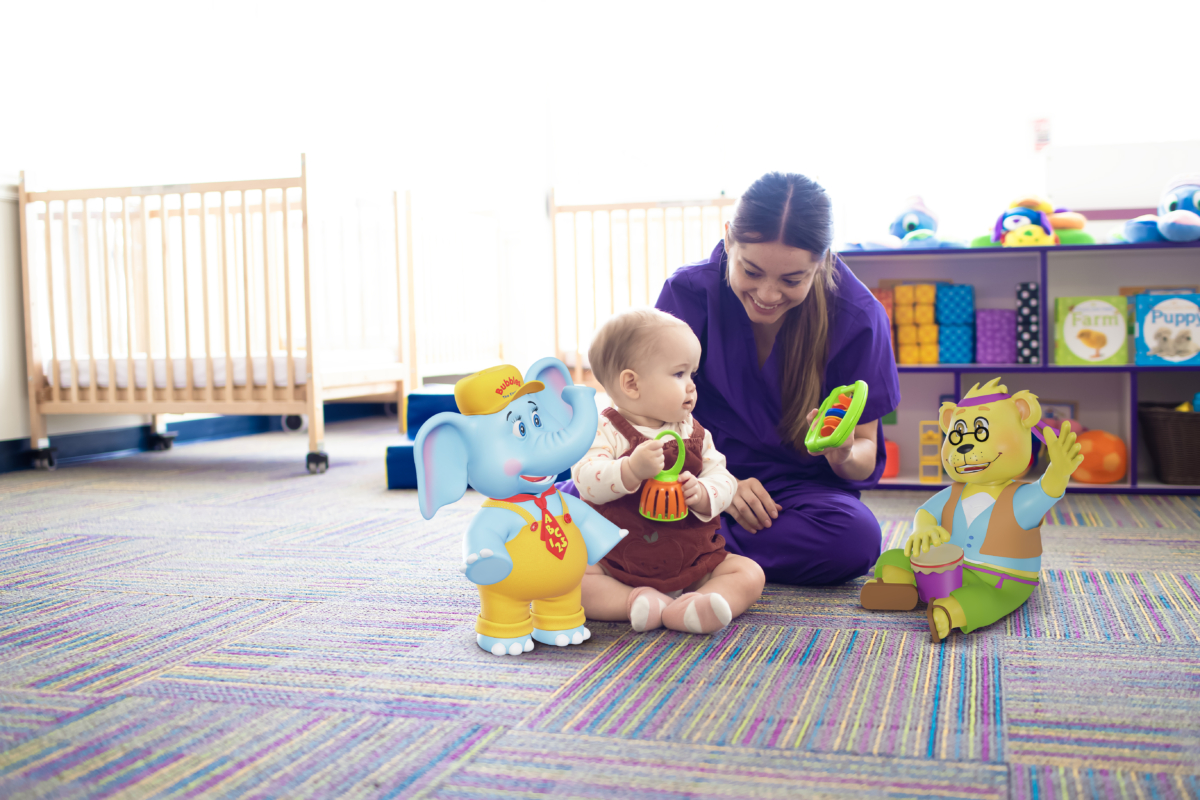
At The Learning Experience, Bongo Bear helps integrate rhythm, movement, and music throughout the daily L.E.A.P.® curriculum experience. TLE's approach to music in early childhood is informed by research from leading music and brain development experts, including Dr Anita Collins, whose work demonstrates how musical engagement builds neural connectivity across language, memory, and cognitive processing. Bongo Bear is also the face of TLE's Little Musicians enrichment program, a dedicated seasonal program that deepens children's musical exploration through instruments, rhythm activities, and creative expression. Music at TLE is not extra enrichment. It is a core instructional tool.
Meet Bongo Bear
"Music and Movement is everywhere, let's hear the beat with Bongo Bear.": Bongo Bear is TLE's rhythm-keeper and the face of the Little Musicians enrichment program. Laid-back, joyful, and always hearing music in everything around him, Bongo shows children that music is not just something you listen to. It is something you live in. Bongo helps children discover that their own body is the first instrument, and that keeping the beat is one of the best things they can do for their growing brain.
Frequently Asked Questions
How does music help preschoolers learn?
Music supports language development, memory, listening, rhythm, coordination, emotional regulation, and social connection. The neural timing systems activated by musical engagement overlap directly with those involved in reading and language processing.
What kind of music is best for young children?
Songs with strong rhyme and repetition, clear rhythmic patterns, and engaging movement elements are most developmentally beneficial for young children. Active musical participation, clapping, dancing, singing along, creates stronger developmental benefits than passive listening.
Want to see our curriculum in action?
Schedule a tour at your nearest The Learning Experience center and watch learning come to life through the characters, activities, and meaningful moments that make TLE different.