Preschoolers are naturally curious. They love to ask questions, explore new textures, move their bodies, and use their imaginations. The best educational activities for preschoolers take advantage of that curiosity and turn everyday play into meaningful learning experiences.
This month, many of our classroom activities are inspired by the theme “Curious Commotion,” where children explore oceans, lakes, rivers, ponds, and the fascinating world of water. The good news for parents is that many of these activities are easy to recreate at home using simple materials you may already have.
Here are some fun and educational preschool activities families can enjoy together while helping children build important early learning skills.
Try a Sink or Float Experiment
Simple science experiments are a great way to encourage curiosity and critical thinking in preschoolers.
Fill a large bowl, bucket, or sink with water and gather household objects like:
- A spoon
- A sponge
- A toy car
- A leaf
- A plastic cup
- A rock
Before placing each object in the water, ask your child:
- “Do you think this will sink or float?”
- “Why do you think that?”
Then, test each item together.
This activity helps children:
- Make Predictions
- Practice observation skills
- Learn new vocabulary
- Understand basic science concepts
The best part is that preschoolers love seeing whether their guesses were correct.
Explore Wet and Dry Sand
If you have access to sand at the beach, playground, or even a small sensory container at home, children can explore how different textures and materials work.
Invite your child to compare wet and dry sand by building sandcastles with both. Ask questions like:
- “Which sand sticks together better?”
- “Which one is easier to scoop?”
- “Why do you think that happens?”
This hands-on activity encourages problem-solving while strengthening fine motor skills.
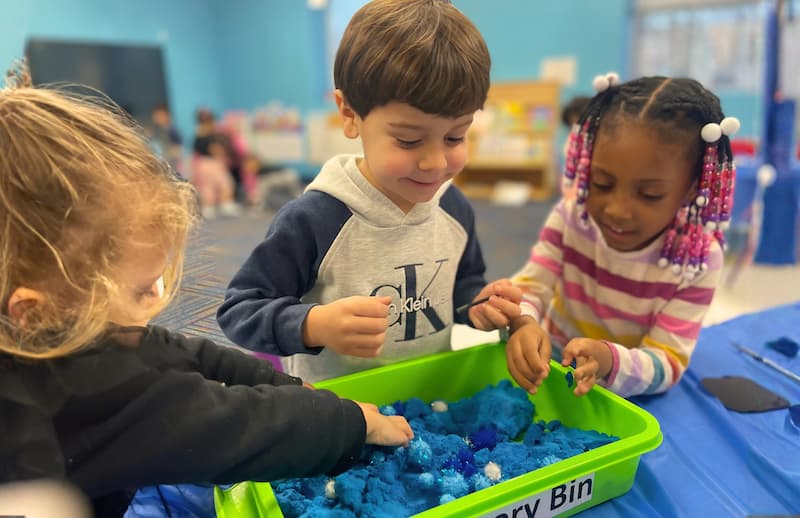
Create an Ocean Sensory Bin
Sensory play is one of the most engaging educational activities for preschoolers because it encourages exploration through touch, movement, and imagination.
To create an ocean-themed sensory bin, you can use:
- Rice or blue colored spaghetti
- Toy ocean animals
- Small cups or scoops
- Shells or rocks
- Blue paper or fabric
As your child plays, tall about different ocean animals and where they live. Encourage pretend play by asking:
- “What do you notice about the animal(s) in your bin?”
- “What would you see underwater?”
Sensory bins also help develop language, creativity, and concentration.
Practice Ocean Animal Movements
Movement activities are a fun way to combine learning and physical activity.
Ask your preschoolers to:
- Waddle like a duck
- Swim like a fish
- Crawl like a crab
- Jump over pretend waves
- Pretend to surf
You can even turn it into a game by calling out different ocean animals and having your child act them out.
These activities support:
- Gross motor development
- Coordination and balance
- Listening skills
- Imaginative play
Plus, they’re a great way to get energy indoors or outside.
Make Ocean Art Together
Creative art projects help preschoolers express themselves while strengthening hand muscles needed for writing later on.
Try creating an ocean mural or artwork together using:
- Paintbrushes
- Sponges
- Rollers
- Cotton balls
- Construction paper
Invite your child to paint waves, fish, turtles, or anything they can imagine underwater.
As they create, ask open-ended questions like:
- “Tell me about your picture.”
- What is happening in the ocean?”
- Why did you choose to create this?”
These conversations help build language and storytelling skills while boosting confidence.
Practice Calming Breathing Exercises
Preschoolers are still learning how to manage big emotions, and calming exercises can help.
One fun strategy is “Starfish Breathing.”
Have your child spread their hand open like a starfish. Using one finger from the opposite hand, slowly trace up and down each finger while breathing in and out slowly.
This simple exercise can help children:
- Slow down and relax
- Practice self-regulation
- Focus on breathing
- Feel calm during overwhelming moments
Making emotional learning playful and approachable is an important part of early childhood development.
Turn Everyday Moments into Learning Opportunities
Educational activities for preschoolers do not need to be complicated or expensive. Simple experiences like exploring water, building sandcastles, pretending to swim, or creating ocean art can support important developmental skills while making learning exciting and memorable.
The key is to follow your child’s curiosity, ask questions, encourage exploration, and make time for playful learning together.
At The Learning Experience, our curriculum is designed to inspire children to explore, discover, and grow through hands-on experiences that make learning exciting.
Themes like “Curious Commotion” help children build academic, social-emotional. And physical skills all while having fun and creating lasting memories.
Because when children are encouraged to ask questions, be creative, and explore the world around them, learning becomes an adventure!