Ages 3-5 | Math & Numeracy | Featured Character: Two Plus Toucan
Ask a preschooler to count to ten and many of them can do it. Ask them to tell you which pile has more blocks, or whether a brick is heavier than a feather, and the task suddenly becomes much harder. This gap reveals something important: reciting number words is not the same as mathematical understanding. And mathematical understanding in the early years is both richer and more important than most realize.
Early numeracy is one of the strongest predictors of academic achievement at school entry. Getting it right means going well beyond counting practice.
What Early Math Is Actually Made Of
Number sense is the foundational mathematical skill in early childhood, and it encompasses far more than sequential counting. It includes cardinality (understanding that the last number counted represents the total quantity), one-to-one correspondence (pointing to each object while counting), and subitizing (instantly recognizing the quantity of a small group without counting).
Equally important are early mathematical reasoning skills: understanding patterns, comparison (more vs. fewer, bigger vs. smaller), spatial relationships, and simple measurement concepts. These form the building blocks of later mathematical proficiency far more reliably than rote counting or numeral identification alone.
The key insight: children who arrive at kindergarten with strong number sense and mathematical reasoning adapt to formal math instruction far more readily than children who have only been drilled on counting sequences.
Why Pattern Recognition Is the Gateway to Mathematical Reasoning
Pattern recognition deserves special attention because mathematics is, at its core, the study of patterns. Children who can identify, extend, and create patterns are building the cognitive architecture that supports algebraic thinking, problem-solving, and logical reasoning throughout their school years. Patterns are everywhere in a preschooler's day: in the rhythm of a song, in the sequence of daily routines, in the arrangement of objects at the table. Naming them, extending them, and inviting children to create their own are all high-value mathematical activities that require nothing but attention and a little playful narration.
How to Build Math Thinking Without Worksheets
The best early math happens in the context of real life. Sorting laundry by color is classification. Setting the table for dinner is counting and correspondence. Comparing which sibling got a bigger piece of fruit is measurement. Noticing that the bathroom tiles form a repeating pattern is algebraic thinking. You do not need special materials to build a mathematical mind. You need deliberate attention to the quantitative structure of everyday experience.
Specific practices worth building into daily life: use comparison language constantly ("which cup has more?" "who has fewer?" "are these the same?"); count objects in real contexts rather than just in sequence; build with blocks and talk about spatial relationships; cook together and use measuring tools; play board games that involve counting and movement.
Most importantly, ask children to explain their reasoning rather than just give an answer. Mathematical thinking develops through the process of justification, not just computation.
How This Comes to Life at The Learning Experience:
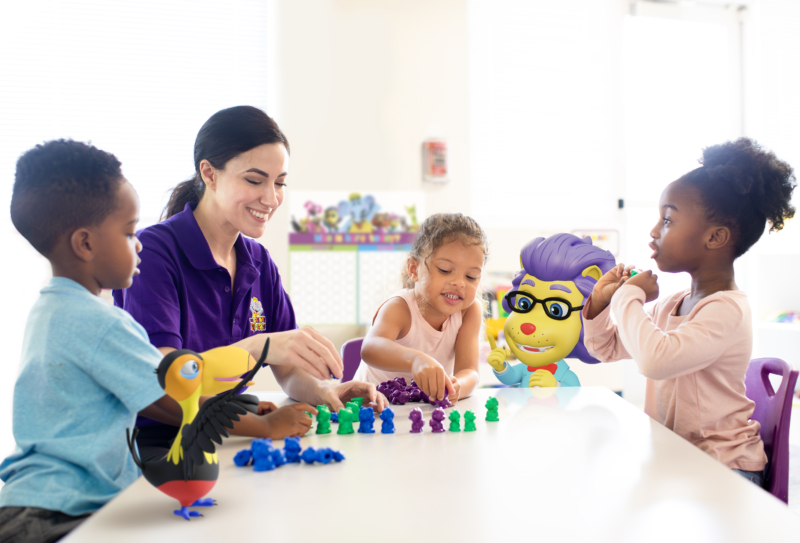
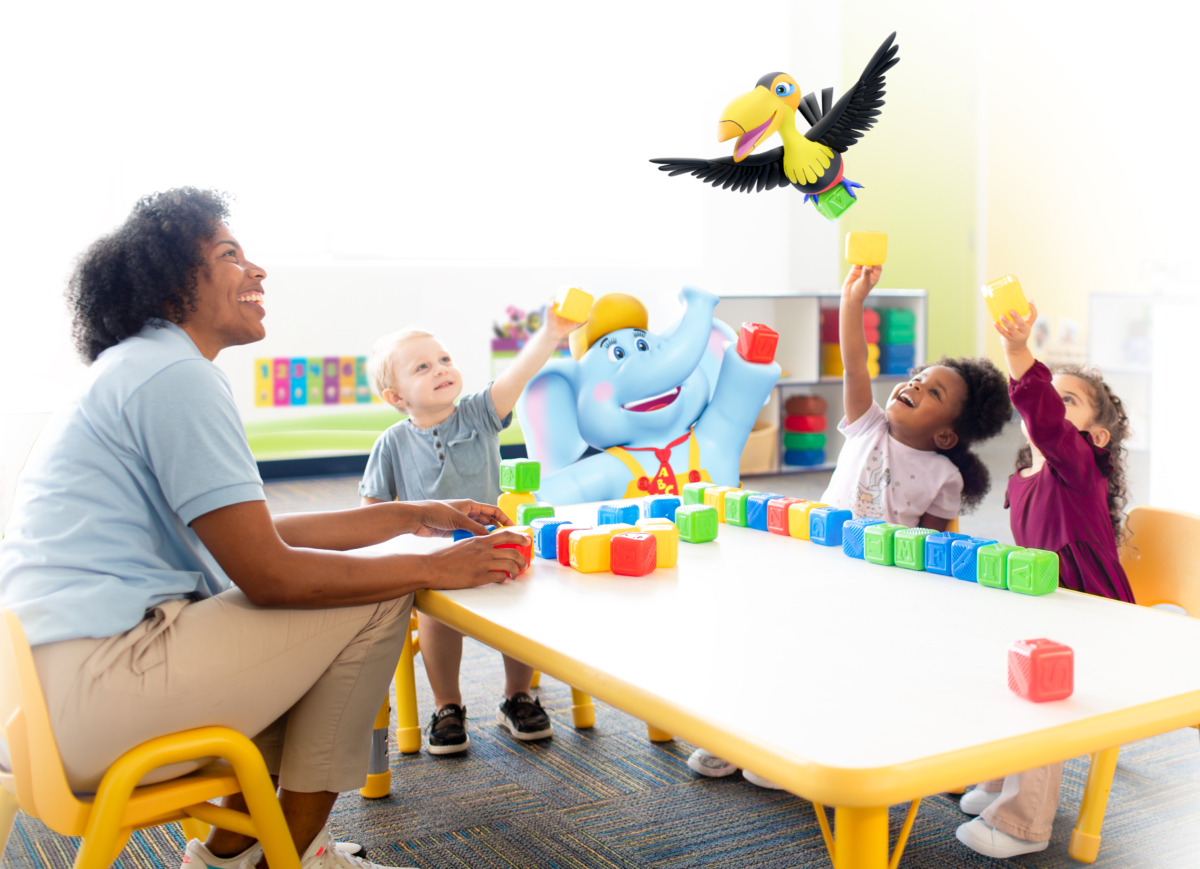
At The Learning Experience, Two Plus Toucan helps bring early math to life through the L.E.A.P.® curriculum's integrated approach to cognitive development and problem-solving. Research cited in Brunick et al. (2016) in the Journal of Children and Media found that toddlers learned mathematical concepts significantly more effectively when engaged by a character with whom they had developed a trusted relationship. TLE's approach with Two Plus Toucan applies this directly: the character appears across the classroom environment through plush toys, workbooks, Circle Time posters, and L.E.A.P.® Interactive boards, creating the layered, trust-building presence that research shows makes learning stick. The goal is not just math knowledge. It is math confidence.
Meet Two Plus Toucan
"Two plus two, it equals four! Let's explore shapes, numbers, and more.": Two Plus Toucan is TLE's mathematical explorer, always looking for numbers, patterns, and quantities hiding in plain sight. From the number of spots on a ladybug to the pattern on a shirt, Two Plus Toucan turns every moment into an opportunity to count, compare, and reason.
Frequently Asked Questions
How do you teach math to preschoolers?
Preschoolers learn math best through hands-on play, counting real objects, sorting and classifying, pattern activities, measurement exploration, shapes, and everyday problem-solving. Research supports embedding math in meaningful real-life contexts over drill-based activities.
What math skills should preschoolers have before kindergarten?
Key math readiness skills include number sense and counting with understanding, one-to-one correspondence, basic shape recognition, simple pattern creation and extension, size and quantity comparison, and early spatial reasoning. Strong number sense is more predictive of future math success than counting ability alone.
Want to see our curriculum in action?
Schedule a tour at your nearest The Learning Experience center and watch learning come to life through the characters, activities, and meaningful moments that make TLE different.